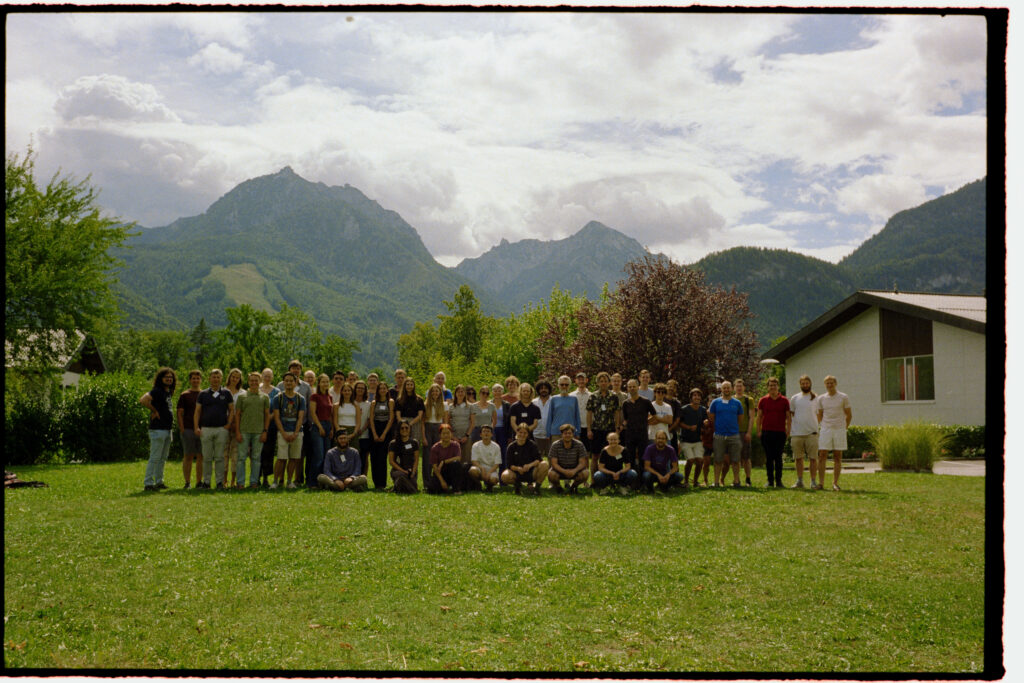
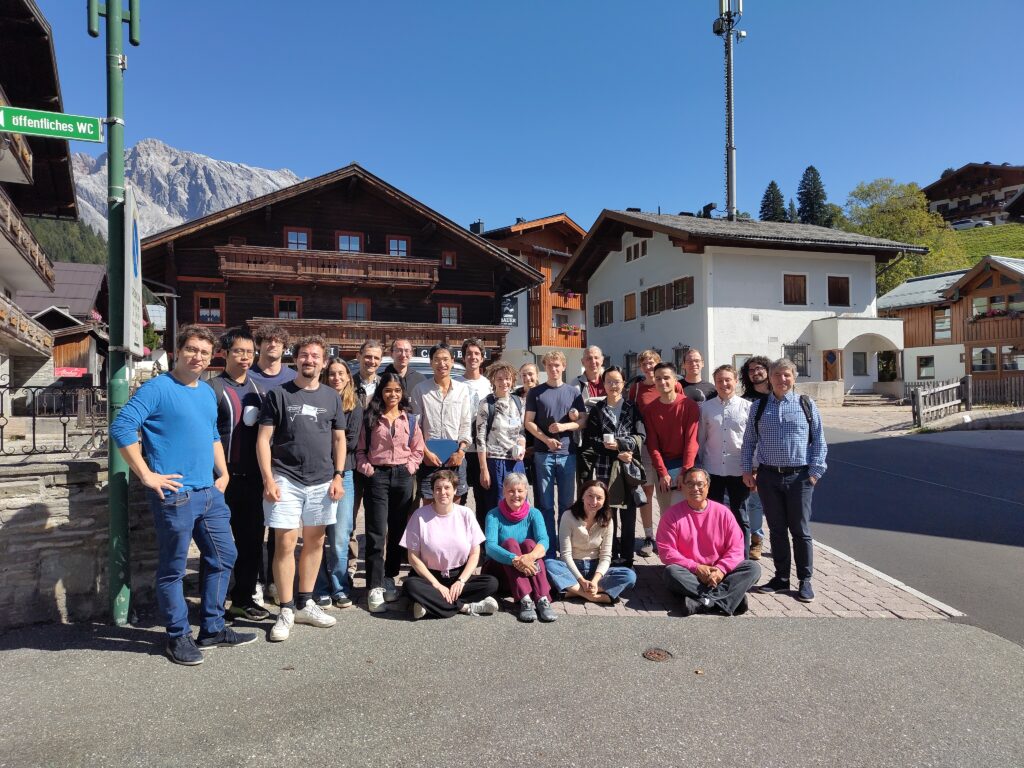
Testimonials by particpants:
Tuan Tung Nguyen (2025): An amazing late-summer week of inspiring math and a landscape straight out of a fairytale! Days filled with morning lectures, afternoon football, and fun without end.
Lena Wallner (2025): The VSM Summer School is a great occasion to learn about other areas of maths and connect with fellow VSM students. My personal highlight is the panel discussion, during which the tutorial speakers answer questions about their careers and offer insights and advice.
Fabian Kleon Zehetgruber (2025): The VSM Summer School is a wonderful opportunity to explore new areas of mathematics and broaden your perspective. In addition to the inspiring lectures, you can talk with the lecturers during coffee breaks or dinner and learn more about their career paths and their life in academia. Beyond the academic program, the summer school offers plenty of fun activities — from hiking and football to games and a riddles rally — that make it easy to connect with fellow PhD students and enjoy a great week together.
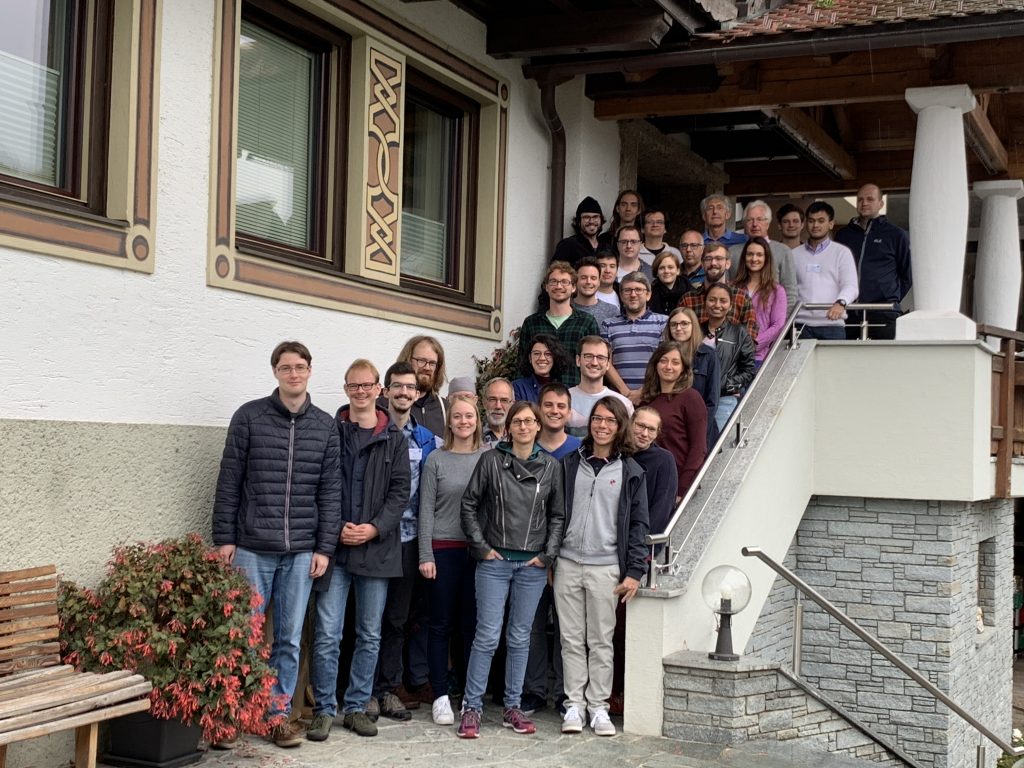
Summer/Winter Schools
The yearly Summer Schools are a central activity of the VSM, which take place in September each year. They offer a perfect opportunity to meet fellow students and socialize with them and at the same time get an introduction to mathematical topics of broader interest. The VSM also organized a Winter School once, but this is not planned to become a regular activity.
VSM Summer School 2027
September 12 – September 18, 2027 in Dienten am Hochkönig.
The School will take place at Universitätssport- und Seminarzentrum Dientnerhof
The confirmed speakers are:
– Stéphanie Nivoche (Université Côte d’Azur)
– Konstantinus Panagiotou (Universität München)
– Julia Wolf (University of Cambridge)
***
Article about this 2026 Summer School
VSM Summer School 2026
August 31 – September 5, 2026 in Strobl am Wolfgangsee.
Lecture series:
Manuel Bodirsky (TU Dresden): Complexity of Constraint Satisfaction
Cordula Reisch (Roskilde University): Mathematical Modeling with Heterogeneous Reaction-Diffusion Equations
Slawomir Solecki (Cornell University): Descriptive Set Theory and its Applications
***
VSM Summer School 2025
September 14 to September 20, 2025 in Dienten am Hochkönig
Lecture series:
David Damanik (Rice University): „Furstenberg’s Theorem and the Anderson Model in the Non-Stationary Setting“
Ewelina Zatorska (University of Warwick): „Mathematical Analysis of Multi-Phase Flow Models“
Single talks:
Andreas Cap (Universität Wien): „Non-involutive distributions“
Michael Drmota (TU Wien): „The Moebius Randomness Principle“
Gerald Teschl (Universität Wien): „Post Quantum Cryptography on one foot“
Christian Krattenthaler (Universität Wien): „Bijections“
***
VSM Summer School 2024
September 15 to September 21, 2024 in Dienten am Hochkönig
Grégory Miermont, École Normale Supérieure de Lyon
Combinatorial and probabilistic aspects of maps
Laure Saint-Raymond, Institut des Hautes Études Scientifiques (IHES)
An introduction to kinetic theory
Bernd Sturmfels, Max Planck Institute for Mathematics in the Sciences Leipzig
Computational Algebraic Geometry
***
VSM Summer School 2023
September 10 to 16, 2023 in Dienten am Hochkönig
Stefanie Sonner, Radboud University
Degenerate Diffusion Equations and Applications in the Modelling of Biofilms
Uli Wagner, IST Austria
Topological Methods in Discrete Mathematics and Theoretical Computer Science
Wadim Zudilin, Radboud University
A Rational Introduction to Irrationality
***
VSM Summer School 2022
18-24 September, 2022 in Weißensee
Arnaud Chéritat, Institut de Mathématiques de Toulouse
One Dimensional Dynamics
Mark Peletier, TU Eindhoven
Some Mathematical Aspects of Deep Learning
Karen Vogtmann, University of Warwick
Moduli Spaces of Graphs and Graph Complexes
***
VSM Summer School 2021
19-25 September, 2021 at Weißensee
Alessandra Iozzi, ETH Zurich
Lattices in SL(n,R), and more…
Joachim Rosenthal, University of Zurich
The mathematical Foundations of Information theory from Claude Shannon
An introduction to Mathematical Coding Theory
An Overview to Public Key Cryptography
Fredi Tröltzsch, TU Berlin
An Introduction to Optimal Control of Partial Differential Equations
***
VSM Summer School 2020
13-19 September, 2020 at Weißensee
Oswin Aichholzer, TU Graz
Crossing numbers of complete and complete bipartite graphs
Elisa Davoli, TU Wien
Effective theories for composite materials: from two-scale convergence to chirality effects
Philipp Petersen, University of Vienna
Four key ideas in data science and machine learning
***
VSM Summer School 2019
22-28 September, 2019 at Weißensee
Alin Bostan, INRIA
Efficient experimental mathematics for combinatorics and number theory
Diogo Gomes, KAUST
An introduction to symbolic mathematics with applications to partial differential equations
Alfio Quarteroni, Politecnico di Milano and Ecole Polytechnique Fédérale de Lausanne (EPFL)
Mathematical and numerical models for multi-physics applications
***
VSM Winter School on Quantum Computation
9-15 March, 2019 in Dienten am Hochkönig
Ämin Baumeler, Austrian Academy of Sciences
Introduction to Quantum Computation
Barbara Kraus, Universität Innsbruck
Entanglement Theory
Norbert Schuch, Max Planck Institute of Quantum Optics
Entanglement in Complex Quantum Systems
***
VSM Summer School 2018
16-22 September, 2018 at Weißensee
László Erdős, IST Austria
Random matrices and disordered quantum systems
Adolfo Quiros Gracián, Universidad Autónoma de Madrid
Elliptic curves and public key cryptography
Hans Schoutens, New York City College of Technology
Ultraproducts at the cross-roads of model-theory, algebra and geometry
***
VDS Summer School 2017
September 2-8, 2017, Obergurgl
Henry Cohn, MIT & Microsoft Research
Packing in high dimensions
Matthias Kreck, Universität Bonn
A panorama of manifolds in dimensions one to eight
Josef Teichmann, ETH Zürich
Affine processes: theory, applications and new developments
***
VDS Summer School 2016
September 18-23, 2016, Obergurgl
Eduard Feireisl, Charles University Prague
The Navier-Stokes millennium prize problem
Joseph M. Landsberg (Texas A&M University, College Station)
Uses of geometry in theoretical computer science